
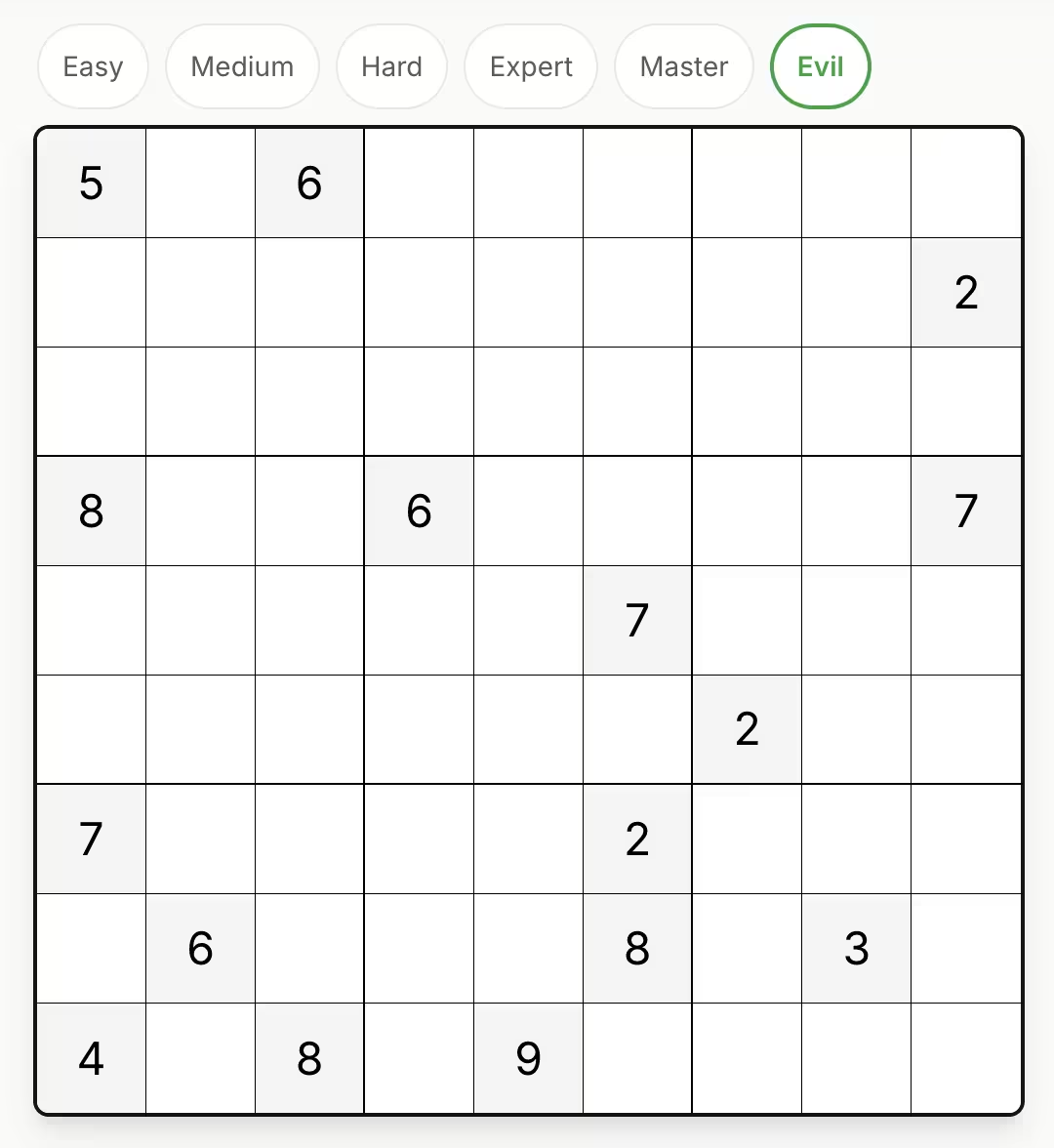
Evil Sudoku gives you exactly 17 numbers. That's it. The mathematical minimum for a unique solution.
Computer algorithms hunt for specific 17-number combinations that break every technique you've learned. Basic elimination? Useless. Naked pairs? Barely scratches the surface. You need Death Blossoms, Jellyfish patterns, and 3D Medusa coloring just to make progress.
Most master-level players quit their first Sudoku Evil attempt. Can't blame them. These puzzles demand 6-12 hour sessions, perfect notation systems, and techniques with names that sound like medieval torture devices.
This guide covers what actually separates evil solvers from everyone else. Not theory—practical strategies that work when you're 4 hours deep and everything looks impossible. Web Sudoku Evil and Online Sudoku Evil platforms exist for the 0.1% who refuse to quit.
Fair warning: Evil Sudoku Puzzles will test your sanity before testing your logic.
🔥 Why 99% of Master Players Quit Evil
🧮 The 17-Number Mathematical Prison
Seventeen is the absolute mathematical minimum for unique solutions. Remove one number from Sudoku Evil 17 puzzles and multiple solutions become possible.
But evil generators don't place those 17 numbers randomly.
Sophisticated algorithms hunt for specific combinations that break conventional solving. These algorithms force exotic techniques: Jellyfish eliminations, Almost Locked Sets, 3D Medusa coloring, Death Blossom chains.
Guessing? Forget it. Miss one logical chain and you'll chase false paths for hours. Every placement requires evidence spanning multiple constraint regions.
⏰ Time Investment Reality
One evil puzzle = 6-12 hours. Sometimes more. Not exaggerating.
I've tested Free Sudoku Evil platforms against Sudoku Evil Printable versions. Paper wins for complex chains—easier to track elimination patterns, draw constraint lines, scratch out failed hypotheses.
Tournament players solve these in 30-60 minutes. But they've practiced 10,000+ hours. Normal people need supernatural patience.
🛠️ Technique Requirements
X-Wing and Swordfish? That's kindergarten for evil level.
You need: Almost Locked Sets, Jellyfish patterns, 3D Medusa coloring, Death Blossom chains, Sue-de-Coq eliminations. These aren't techniques—they're logical frameworks requiring months to master.
No pattern memorization shortcuts. Every evil puzzle combines these frameworks differently.
Expect 6-12 months of study before reliably spotting advanced patterns.
🧙 Evil Techniques That Break Minds
⚠️ Unique Rectangle: Impossibility Logic
Four cells forming a rectangle. Same two candidates in each cell. If both numbers could fill all positions, multiple solutions become possible.
Sudoku promises unique solutions. Deadly rectangles violate that promise.
When you spot potential deadly rectangles forming, eliminate candidates that would complete the impossible pattern. Using impossibility as an elimination tool.
Simple theory. Nightmare execution.
You're tracking nine rows, columns, boxes simultaneously while monitoring dozens of logical relationships. Takes months before pattern recognition becomes reliable.
🌸 Death Blossom: Multi-Chain Logic
Central "stem" cell connects to multiple "petal" cells across different regions. These connections create logical chains that interact for remote eliminations.
Don't ask how it works. Nobody truly understands Death Blossom intuitively.
You're juggling 4-6 cells simultaneously. Lose one connection and the entire logical structure collapses.
Takes 6-12 months before Death Blossom recognition becomes reliable. But it unlocks "impossible" puzzles no other technique touches.
🌈 3D Medusa: Advanced Coloring Networks
Regular coloring tracks single chains. 3D Medusa tracks multiple interconnected networks across regions and candidates simultaneously.
Different colors represent different logical relationships. You analyze how these networks interact—supporting each other or creating contradictions.
Requires exceptional spatial reasoning. Miss one network connection and you'll chase false eliminations for hours.
Pro tip: invest in quality colored pencils. Cheap ones smudge and you'll lose track of complex networks.
🧠 What Evil Sudoku Does to Your Mind
⚡ Cognitive Transformation
Evil Sudoku rewires neural pathways. Not hyperbole—measurable cognitive changes occur.
Around month six, complex logical tracking becomes automatic. This enhancement transfers to unrelated domains.
Programming debugging improves dramatically. Mathematical problem-solving accelerates. Research supports this: advanced puzzle practice enhances pattern recognition, working memory, and systematic thinking.
Colleagues report similar transformations. Real cognitive training, not app-based gimmicks promising quick fixes.
🎯 Extended Focus Training
Evil puzzles require 4-10 hour focus sessions. Uninterrupted. Complete environmental control.
Sounds extreme? It is. But concentration capacity adapts to demands.
This focus transfers everywhere. Work meetings where others fade after 30 minutes? Easy now. Complex project analysis that exhausts colleagues? Manageable.
Warning: absorption becomes dangerous. You'll forget meals, lose track of time, emerge from sessions disoriented. Set alarms.
👁️ Enhanced Pattern Recognition
Evil practice changes visual processing fundamentally. Pattern recognition operates faster than conscious analysis.
Programming benefits appear first. Bug detection accelerates, architectural problems become obvious before implementation. Other developers report identical improvements.
Chess players notice tactical vision enhancement. Strategic game improvement correlates with evil sudoku practice duration.
The pattern recognition transfer seems legitimate. Advanced logical training enhances cognitive processing across domains.
🙅 Mistakes That Kill Evil Progress
🎯 Guessing Instead of Logic
Most players start guessing when basic techniques fail. Fatal mistake.
I wasted months this way. Simple elimination would stop working, so I'd test random numbers. Hours down false paths before realizing my "hypothesis" corrupted everything.
Evil puzzles punish guessing brutally. One wrong assumption creates cascading false eliminations. Learn advanced techniques instead of hoping luck saves you.
🔄 Ignoring Mental Fatigue
Intense focus creates tunnel vision after 90-120 minutes. You'll miss obvious patterns while obsessing over complex chains.
I learned this through painful repetition. Four hours stuck, walking away frustrated, returning to immediately spot missed opportunities.
Force breaks every 90 minutes now. Let subconscious processing occur. Counterintuitive but essential for evil-level solving.
📝 Notation System Failure
Evil puzzles generate massive candidate density and complex logical chains. Mental tracking becomes impossible.
Develop systematic notation early. Clear candidate marking, color-coded chain tracking, systematic elimination recording. Messy notation equals confused logic.
People solve identical cells multiple times due to illegible marks. Don't waste hours on notation failures.
🛠️ Essential Evil Tools
📱 Digital vs Paper Solving
Free Sudoku Evil platforms handle automatic candidate management. Convenient but potentially dependency-creating.
Paper forces manual tracking. More initial effort but deeper logical understanding. Choose based on puzzle complexity and personal preference.
For maximum complexity puzzles, paper dominates. Margin annotations, constraint arrows, messy hypothesis tracking—digital can't match this flexibility.
📚 Advanced Technique Learning
YouTube explanations show technique mechanics but not pattern recognition in real puzzles.
Better: specialized puzzle collections designed for technique training. Progressive difficulty examples until recognition becomes automatic.
Nikoli books provide excellent technique explanations with targeted practice puzzles. Essential investment for serious evil-level advancement.
📅 Systematic Practice Progression
Jumping to maximum difficulty creates frustration and abandonment.
Spend months on graduated progression. Start with hard puzzles requiring basic advanced techniques. Gradually approach true evil difficulty.
Daily consistency surpasses intensive bursts. One challenging daily puzzle teaches more than weekly binge sessions.
🧠 The Evil Sudoku Psychology
🎯 Pure Problem-Solving Addiction
Evil Sudoku provides pure problem-solving without external distractions or artificial time constraints.
No designed addiction mechanics like games or social media. No notifications, rewards, engagement manipulation. Just logical reasoning versus mathematical constraints.
This purity creates addiction. When life feels chaotic, evil puzzles provide controllable environments where logic guarantees solutions.
🎢 Frustration-Euphoria Cycles
Evil puzzles create extreme frustration followed by massive breakthrough satisfaction.
This emotional cycle drives addiction. Struggle intensity amplifies solution euphoria. Psychological dopamine manipulation through difficulty.
Weekend-long battles with single puzzles. Multiple abandonment attempts. "One more approach" becomes hours. Final breakthrough = pure cognitive euphoria.
👥 Isolation and Community
Sudoku remains fundamentally solitary. Crowdsourcing solutions defeats the cognitive training purpose.
This isolation attracts specific personalities. No team dynamics, social pressure, communication requirements. Pure individual skill versus mathematical constraints.
Online communities share challenging puzzles and technique discussions. Social elements around individual practice rather than collaborative solving.
⚠️ Should You Attempt Evil?
Struggling with master puzzles? Skip evil level entirely.
Not kidding.
Master expert-level consistency first. Evil isn't incrementally harder—it's categorically different. When expert feels routine (not lucky), consider evil attempts.
Sudoku Evil Online Free and Printable Sudoku Evil platforms exist for the masochistic 0.1%.
Evil demands total commitment. No multitasking, no casual attempts. These puzzles require patience, systematic analysis, willingness to learn techniques that sound fictional.
Websudoku Evil provides graduated training. Sudoku Evil Select offers complexity progression.
Don't self-deceive about readiness. Genuine preparation is obvious when achieved.
⌛ Time Investment Reality Check
📊 Actual Time Requirements
Evil Sudoku isn't casual entertainment. It's cognitive mountaineering.
Expect 50-100 hours learning advanced techniques before solving your first evil puzzle. Another 200-500 hours developing consistent competency.
Comparable to learning musical instruments or programming languages. Serious skill development, not weekend hobby dabbling.
⚖️ Opportunity Cost Analysis
Is 300+ hours of evil sudoku optimal time investment? Depends on personal goals and values.
Practical skill development: programming or languages provide better ROI. Entertainment: games offer more variety and social interaction.
Pure logical challenges and solitary intellectual pursuit? Evil Sudoku provides unique cognitive satisfaction unavailable elsewhere.
📈 Building Sustainable Practice
Most quit after initial attempts. Evil puzzles are genuinely difficult and psychologically draining.
Start with 15-30 minute daily technique sessions. Gradual progression prevents burnout from overwhelming marathon attempts.
Track progress systematically. Document technique mastery, puzzle completion times, pattern recognition development. Incremental victories sustain motivation through inevitable plateaus.
🎆 Evil Sudoku Resources
📱 Platform Comparison
Free Sudoku Evil platforms provide automatic candidate tracking and intelligent hint systems. Optimal for learning since software manages notation complexity.
Printable Sudoku Evil forces manual tracking. Additional effort but stronger spatial memory development. Paper remains superior for maximum complexity—connection drawings, chain elimination tracking.
Sudoku Evil Printable collections from Nikoli contain meticulously crafted puzzles with elegant solution architectures. Books cost $15-25 but provide months of elite practice material.
📅 Training Progression
Start with 15-30 minute daily sessions. Pattern recognition requires consolidation between practice sessions.
Months 1-2: Master advanced techniques on hard puzzles
Months 3-6: Attempt first evil difficulty puzzles
Months 7-12: Develop consistent evil solving competency
Document progress systematically. Track technique mastery, pattern recognition development, completion time improvements. Progress tracking maintains motivation through extended plateaus.
🏆 Your Evil Mastery Journey
Evil Sudoku separates casual solvers from dedicated logic masters. Requires 300+ hours of focused practice for consistent competency—comparable to serious musical or programming skill development.
For committed players, cognitive benefits transfer extensively. Enhanced pattern recognition, systematic problem-solving, mental endurance applicable to professional challenges.
You'll know whether Websudoku Evil suits you within initial attempts. If you analyze puzzle patterns during unrelated activities, you're developing mastery-level obsession.
If frustration dominates fascination, no shame in stopping. Other cognitive challenges might better match your learning preferences.
Either outcome teaches valuable lessons about personal problem-solving capabilities and preferences.
Frequently Asked Questions
How long does it take to master evil Sudoku?
Most players require 1-3 years of consistent practice to achieve evil-level competency. You're not just learning techniques—you're building advanced pattern recognition that only develops through extensive repetition.
Can evil Sudoku be solved without guessing?
Yes. Evil puzzles are designed to have unique solutions achievable through logical deduction alone. If you're guessing, you're missing advanced techniques like 3D Medusa, Death Blossom, or Almost Locked Sets.
What's the hardest technique to learn for evil level?
Death Blossom patterns challenge most players severely. You're tracking multiple logical chains simultaneously across scattered cells, which taxes working memory beyond normal capacity.
How many people can actually solve evil Sudoku?
Roughly 0.1-0.5% of Sudoku players can consistently solve evil difficulty puzzles. It represents the absolute peak of human logical reasoning in puzzle-solving contexts.
Should I use software or paper for evil puzzles?
Both have advantages. Software handles candidate management automatically but may create dependency. Paper allows flexible notation but requires manual tracking. Most experts use hybrid approaches.
What makes evil Sudoku different from master level?
Evil uses only 17 starting numbers—the mathematical minimum. This forces exotic techniques rarely needed at master level and creates solving sessions lasting 6-12 hours.
Are there cognitive benefits to evil Sudoku practice?
Research suggests advanced puzzle solving enhances pattern recognition, working memory, and systematic thinking. Benefits transfer to programming, mathematical reasoning, and strategic analysis.
How do I know if I'm ready for evil difficulty?
You're ready when master puzzles feel routine rather than challenging. Consistent solving under 2 hours, comfortable with all advanced techniques, and genuine enjoyment of complex logical challenges.
🎯 Discover the Complete Sudoku Universe
📊 Complete Difficulty Progression
Explore our scientifically designed progression to find your perfect challenge:
🟢 Easy Sudoku Classic Sudoku
Perfect for building fundamental logical reasoning skills with a friendly learning environment.
🟡 Medium Sudoku Classic Sudoku
The next step with balanced challenge and solvability, developing intermediate techniques.
🔴 Hard Sudoku Classic Sudoku
Requires advanced techniques and strategic thinking with complex patterns and logical chains.
🟣 Expert Sudoku Classic Sudoku
Challenges even experienced solvers with intricate patterns requiring mastery of advanced techniques.
🔵 Master Sudoku Classic Sudoku
Elite puzzles requiring mastery of all techniques, representing the pinnacle of sudoku skill.
⚫ Evil Sudoku Classic Sudoku ✓
The ultimate challenge designed to test the absolute limits of human logical reasoning capabilities.
🎮 Alternative Sudoku Types
Expand your puzzle-solving horizons with these exciting variations that offer unique challenges and cognitive skills:
🔢 Killer Sudoku
Combines Sudoku with arithmetic constraints in defined cages, adding mathematical reasoning to logical deduction.
🎯 Giant 16x16 Sudoku
Massive grid challenges with hexadecimal logic, providing extended solving sessions and enhanced pattern recognition.
🧸 Kids Sudoku
Child-friendly 4x4 and 6x6 grids designed to introduce young minds to logical thinking and pattern recognition.
📚 Learning Resources
Comprehensive guides, strategies, and tutorials to master sudoku techniques from beginner to advanced levels.
📋 Readiness Assessment
Evil Sudoku represents the absolute pinnacle of puzzle-solving difficulty. With only 17 starting numbers, these puzzles demand mastery of exotic techniques like Death Blossom, 3D Medusa coloring, and Almost Locked Sets. Most players who reach master level never attempt evil—and that's perfectly reasonable.
Evil readiness requires consistent master-level solving under 2 hours, comfort with all advanced techniques, and genuine enjoyment of extended logical challenges that can span entire weekends. This represents the top 0.1% of puzzle solvers globally.
😈 The Ultimate Challenge
You've reached the edge of human logical reasoning. Evil Sudoku exists for the 0.1% who find master puzzles too easy. With only 17 numbers, these puzzles will test every cognitive skill you've developed and push you beyond what seems possible.
Fair warning: evil Sudoku changes you. The pattern recognition, systematic thinking, and mental endurance you develop here doesn't stay confined to puzzles. You'll notice it everywhere—in your work, your problem-solving, your ability to think through complex challenges that defeat others.