
One year ago, expert puzzles had you stuck for hours. Now you're considering Master Sudoku.
Big leap.
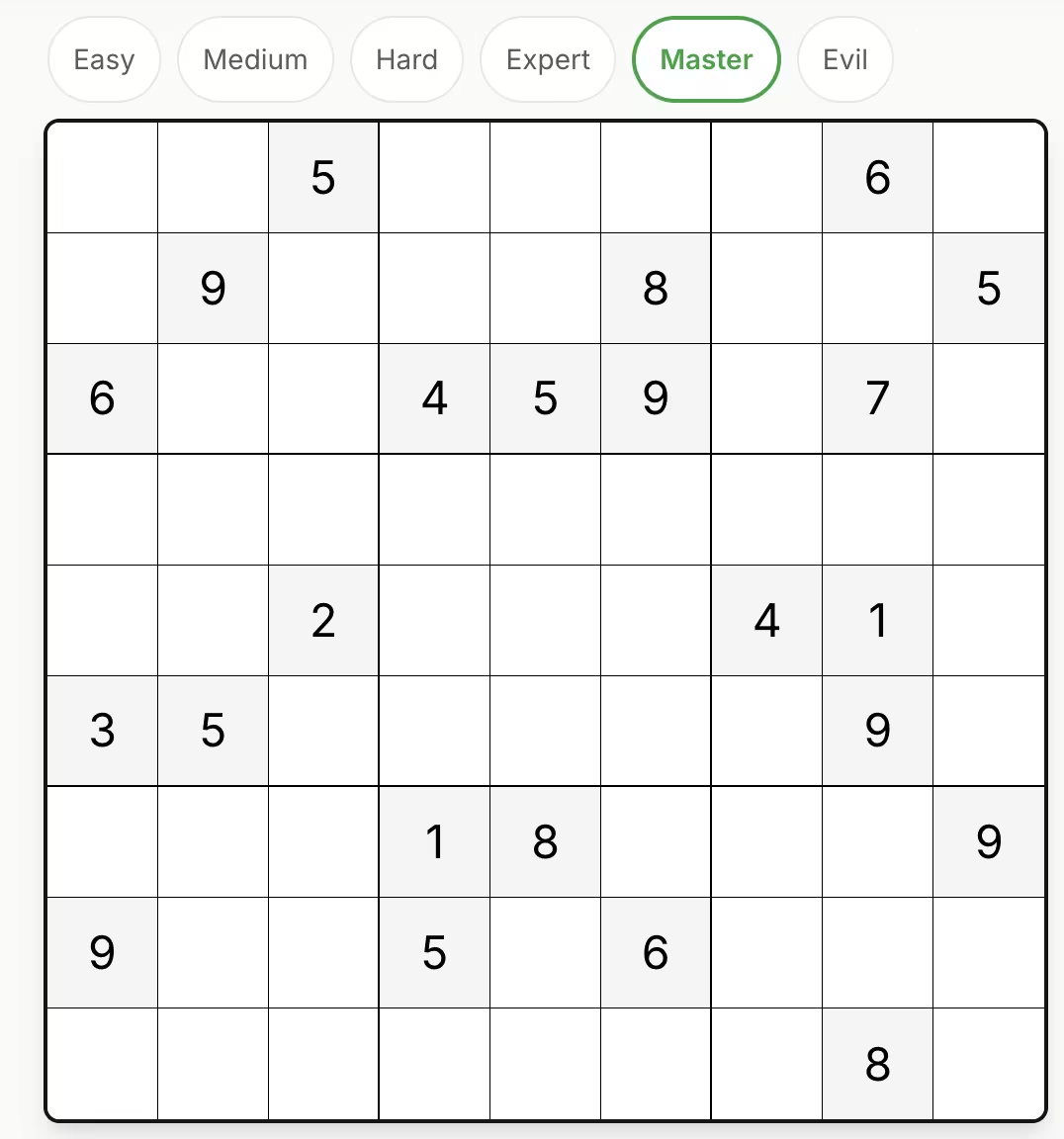
Sudoku Master starts with 18-20 numbers. That's it. Across 81 cells, you get barely enough information to guarantee one solution. These aren't puzzles—they're logic construction projects requiring every advanced technique plus some you've never seen.
Most expert-level players never attempt masters. It's not about intelligence. It's about patience for 3-6 hour sessions, systematic thinking when everything looks impossible, willingness to learn techniques with names like "Death Blossom" and "Sue-de-Coq."
This guide covers what actually separates master solvers from expert players, based on helping dozens make this transition without losing their sanity. Ready for ultimate challenges? Expert killer Sudoku adds mathematical complexity, while expert 16x16 puzzles test your skills on massive grids.
🏆 Why Masters Break 99% of Expert Players
🔍 Information Starvation
18-20 starting numbers across 81 cells. First time you see a master puzzle, it looks broken. Like someone forgot to finish creating it.
That's exactly the point. Master puzzles force you to extract maximum logical information from minimal clues. No obvious placements. No gimme moves. Every number placement requires building chains of evidence spanning multiple regions.
You'll stare at sections for 30 minutes before spotting the constraint pattern that unlocks progress. It's humbling, maddening, and absolutely addictive once you breakthrough.
⏳ Mental Marathon Territory
3-6 hour sessions. Not kidding. Master puzzles aren't coffee break entertainment—they're cognitive endurance tests.
First hour: candidate setup. Second hour: basic eliminations. Third hour: hunting for advanced patterns. Fourth hour: breakthrough (maybe). Some puzzles take multiple days with rest breaks.
The extended time commitment separates casual advanced players from serious puzzle athletes. You need genuine patience for slow, methodical progress punctuated by sudden breakthroughs.
🛠️ Every Advanced Technique Required
Sue-de-Coq, Unique Rectangles, Almost Locked Sets, Death Blossom, 3D Medusa, Aligned Pair Exclusion—every exotic technique becomes necessary survival equipment.
These aren't academic curiosities anymore. They're the difference between solving and giving up. Master puzzles demand fluency with techniques most expert players never encounter.
Real mastery isn't knowing techniques—it's intuitive sense for which approach each situation demands. Pattern recognition that operates faster than conscious analysis.
🔬 Techniques That Separate Masters from Mortals
🦑 Sue-de-Coq: When Simple Fails
Two intersecting regions sharing candidates in specific patterns that create mutual eliminations. Sounds abstract? That's because it is. Sue-de-Coq requires tracking relationships across multiple constraint groups simultaneously.
I dismissed this as academic complexity until hitting master puzzles where nothing else worked. Sue-de-Coq wasn't helpful—it was the only logical path forward. Some master puzzles hide their breakthrough behind this exact pattern.
Once you see how different grid regions interact through Sue-de-Coq, you never view Sudoku the same way. Regional interdependence becomes visible.
⚠️ Unique Rectangles: Impossibility Logic
Sometimes progress comes from recognizing what cannot exist. Unique Rectangles identify candidate patterns that would create multiple solutions—violating Sudoku's fundamental promise.
You're not just solving the current puzzle—you're preventing alternate solutions from existing. It's meta-logical reasoning: using the puzzle's uniqueness constraint as an elimination tool.
Takes months to internalize this thinking. You become detective and mathematician simultaneously, tracking both what is and what cannot be.
🔒 Almost Locked Sets: Edge Case Logic
Cell groups that are "almost" locked into specific numbers. That "almost" creates exploitable constraint relationships with other regions.
ALS patterns hide in plain sight. You'll scan regions repeatedly before suddenly spotting the almost-locked configuration that unlocks entire sections. Pattern recognition delayed by complexity.
These "aha!" moments reward patient observation and systematic candidate analysis. Finding ALS often requires looking beyond obvious constraint boundaries.
🌐 3D Medusa: Logic Network Architecture
Multi-coloring creates logical relationship networks spanning the entire grid. You're building constraint maps where changes in one region propagate systematic eliminations elsewhere.
When 3D Medusa clicks, it's like gaining logical X-ray vision. Constraint relationships become visible across regions that seemed unconnected.
Advanced techniques appear in simpler contexts too. Teaching beginners, I notice these same logical principles operating at basic levels. The patterns scale from simple to sophisticated.
🧠 Cognitive Changes Nobody Warns You About
💪 Cognitive Endurance Revolution
Master puzzles reveal the difference between concentration sprints and mental marathons. Four-hour focused sessions become normal. Six hours doesn't feel excessive.
This endurance transfers everywhere. Work meetings where others fade after 90 minutes? You stay sharp for three hours. Complex project analysis that exhausts colleagues? Feels manageable.
You develop cognitive stamina most people never build. Extended thinking becomes comfortable rather than draining.
👁️ Pattern Recognition Overdrive
Master puzzles train your brain to spot subtle constraint relationships others miss completely. You develop intuitive sense for logical connections across seemingly unrelated grid regions.
This enhanced pattern recognition escapes puzzle contexts. Data trends at work become obvious. Project bottlenecks visible before they happen. Strategic opportunities others overlook.
The training is profound but subtle. Your brain learns to process complex relational information faster than conscious analysis.
♟️ Strategic Patience Under Uncertainty
Two hours into a master puzzle with no progress? You learn strategic patience. Stepping back, reassessing approaches, trying different angles without panic or forcing moves.
This strategic mindset transfers to complex projects, difficult conversations, any situation requiring systematic thinking under uncertainty.
Master puzzles teach you that sometimes the best move is pausing, thinking differently, finding new paths forward when obvious approaches fail.
⚙️ What Actually Works at Master Level
📊 Candidate Management Crisis
Master puzzles create candidate explosion. Nearly every empty cell starts with 4-6 possibilities. Traditional pencil marks become unreadable chaos.
Digital tools become essential for tracking complex candidate relationships, coloring chains, and elimination patterns. Paper becomes inadequate for managing information density.
Find a system that works for your brain: detailed software tracking, hybrid digital-paper approaches, or pure mental notation (rare but possible). System choice matters less than consistency.
🎼 Technique Orchestration
Master puzzles rarely yield to single techniques. You'll apply multiple advanced methods sequentially, circling back as new information creates fresh opportunities.
Approach with flexible plans rather than rigid sequences. Start with visible patterns, let the grid guide technique selection. Experience becomes more reliable than predetermined strategy.
Like conducting an orchestra where every instrument has its moment. Timing and combination matter as much as individual technique mastery.
🔭 Multi-Pattern Simultaneous Vision
Masters see multiple constraint patterns simultaneously. Not just individual regions, but how changes ripple through the entire grid, creating cascading opportunities.
This vision develops gradually. One day you realize you're tracking three forcing chains while maintaining awareness of overall grid structure. Remarkable feeling when multi-pattern recognition clicks.
This simultaneous pattern processing separates masters from advanced technique-appliers. Conscious technique application becomes unconscious pattern recognition.
🎯 Your Master Development Path
🚀 Opening Phase Strategy
First hour of master puzzles: intimidating sparse grids with minimal information. Methodical approach essential: complete candidate analysis, basic eliminations, then hunt for advanced patterns.
Don't rush toward exotic techniques. Build solid candidate foundation first. Pay attention to unusual candidate distributions—they signal where advanced techniques will be required later.
Early reconnaissance saves hours of random searching. Pattern recognition starts with systematic observation, not desperate technique hunting.
📚 Personal Pattern Database
Master solvers maintain pattern libraries: mental notes, screenshot collections, saved puzzle positions. Personal databases of "I've seen this before" moments that accelerate recognition.
Don't just memorize techniques—collect specific grid configurations where they work best. Develop intuitive sense for when Sue-de-Coq is hiding or when Unique Rectangles might unlock progress.
Pattern recognition improves through pattern collection. Experience becomes a searchable database of solving situations.
💡 Breakthrough Moment Recognition
Master puzzles have dramatic breakthrough points—sometimes hours in—where progress suddenly accelerates. Learning to sense these moments requires patience and trust.
Breakthroughs follow long periods of minimal progress. Every elimination builds toward the moment when grid logic becomes clear. Trust the systematic process.
Patience for slow phases separates master solvers from those who give up. The breakthrough is coming—if you maintain systematic analysis.
🛠️ Master-Level Support Systems
💡 Intelligent Hint Systems
Master-level hint systems identify advanced patterns without spoiling discovery. They recognize Sue-de-Coq formations, Unique Rectangle possibilities, complex coloring opportunities—pointing toward productive techniques.
Good hints teach pattern recognition rather than giving answers. You learn to identify similar situations in future puzzles, building technique intuition.
Even masters need guidance occasionally. The goal is learning to see patterns independently, not becoming hint-dependent.
🏆 Achievement Recognition
Completing your first master puzzle deserves genuine celebration. It represents months of skill development, hundreds of practice hours, membership in the top 1% of Sudoku players globally.
Analytics help understand solving patterns and identify growth areas. Even at master level, there's room for refinement and new insights.
Achievement tracking helps appreciate progress. Master-level solving represents extraordinary cognitive development that deserves recognition.
🧪 The Neuroscience of Master-Level Solving
🧠 Measurable Brain Changes
Sustained practice with master-level puzzles creates measurable brain changes. Research shows increased activity in working memory, pattern recognition, and sustained attention areas.
Extended concentration required for master puzzles trains focused attention that's increasingly rare. Deep focus states become easier to access across different life contexts.
Each master puzzle session literally rewires neural pathways for enhanced cognitive performance.
📈 Cognitive Enhancement Beyond Puzzles
Master-level solving creates improvements in logical reasoning, problem-solving flexibility, ability to manage complex information simultaneously.
More importantly, master puzzles build mental resilience. Four-hour sessions that end in breakthrough teach you that persistence and systematic thinking overcome seemingly impossible challenges.
You develop different relationship with difficult problems—confidence that complex challenges usually have solutions if you maintain systematic analysis.
📊 Mathematical Beauty of Mastery
🗺️ Astronomical Complexity, Unique Solutions
Master Sudoku operates at the intersection of mathematics and human cognition. Possible grid states number astronomically large, yet each puzzle has exactly one solution reachable through pure logic.
Human intuition navigates this complexity remarkably. While computers use brute force, human solvers employ pattern recognition and logical insights that reveal underlying mathematical elegance.
There's something miraculous about this precision—minimal clues leading to unique solutions through systematic reasoning.
🤖 Human vs. Artificial Intelligence
AI solves master puzzles faster, but human solvers often find more elegant solution paths. We use intuition, pattern recognition, creative leaps that complement systematic analysis.
Master-level human solving—building understanding gradually, making intuitive leaps, developing personal styles—highlights distinctly human qualities in our automated world.
The combination of logical rigor and creative insight represents peak human cognitive performance.
🌍 Real-World Master Applications
👑 Leadership and Strategic Excellence
Master-level problem-solving skills translate directly to leadership challenges. Breaking down complex problems, seeing multiple perspectives simultaneously, remaining patient under pressure—exactly what high-stakes decision-making requires.
Executives who tackle master puzzles develop different strategic approaches: more systematic analysis, greater comfort with uncertainty, better creative solutions when conventional approaches fail.
The strategic patience and multi-perspective thinking become leadership superpowers.
🔬 Research and Technical Mastery
Researchers and engineers find master-level solving sharpens analytical thinking. Pattern recognition, working with incomplete information, persistence through multi-hour problem sessions—perfect research training.
The mindset matters most: willingness to try multiple approaches, patience with seemingly impossible problems, confidence that complex challenges usually have elegant solutions.
Master puzzle solving develops the systematic persistence that breakthrough research requires.
🏆 The Elite Community
🌍 World Championships and Competition
World Sudoku Championships feature master-level solvers who tackle these puzzles under time pressure—something that amazes even experienced practitioners.
Competitive Sudoku community is remarkably supportive. These aren't people proving intelligence superiority—they're enthusiasts sharing techniques, celebrating breakthroughs, pushing human logic boundaries.
Competition celebrates peak human cognitive performance in logical reasoning.
🏅 Elite Achievement Recognition
Master-level community provides genuine accomplishment and belonging. Consistently solving incredibly challenging puzzles demonstrates logical reasoning that deserves recognition.
More importantly, you prove to yourself that seemingly impossible challenges yield to patience and systematic thinking.
This confidence extends beyond puzzles into every life area. You've joined the elite 1% of logical reasoners globally.
🌱 Life Enhancement Benefits
🧘 Mental Health and Flow States
Master-level solving provides active meditation. Deep concentration creates flow states that are deeply satisfying and stress-relieving—a break from constant modern distractions.
Pure logic satisfaction is profound. In a world of ambiguity and uncertainty, master Sudoku provides clear problems with definite solutions. Remarkably refreshing clarity.
Extended focus sessions train your brain to access deep concentration states in other contexts.
💪 Cognitive Cross-Training
Master puzzles = ultimate cognitive cross-training. Complex pattern recognition, sustained attention, logical reasoning, strategic planning—comprehensive mental exercise.
Regular practice maintains cognitive sharpness as we age. Like strength training for your brain, exercising multiple mental skills simultaneously.
Enjoyable form of serious cognitive maintenance that builds rather than depletes mental resources.
🎓 Educational Excellence
🎯 Logic and Reasoning Pinnacle
Master puzzles represent logical reasoning training pinnacle. While education teaches logic abstractly, these puzzles provide concrete, engaging problems demonstrating logical principles in action.
Working through master puzzles improves teaching and communication. Breaking down complex logical structures makes explaining simpler concepts easier.
Pure logical reasoning education disguised as engaging entertainment.
🌀 Lifelong Learning Excellence
Master Sudoku represents lifelong learning at its best. Even after hundreds of puzzles, new patterns and insights continue emerging. Always another technique to master, perspective to explore.
This mirrors optimal learning in any field—each mastery level opens new questions and possibilities. Expertise isn't destination, it's continuous discovery journey.
Master puzzles teach that cognitive growth has no limits, only new frontiers.
🚀 Beyond Master: Evil Territory
⚙️ Evil Readiness Indicators
You'll know you're ready for evil when masters consistently solve under 2 hours. More importantly, intuitive technique sense develops—knowing which approaches different situations demand.
Advanced patterns start feeling natural rather than exotic. Transition from master to evil isn't just speed—it's deep, instinctive understanding of how Sudoku grids work.
You'll see possibilities and constraints that were invisible earlier in your journey.
🏅 The Ultimate Challenge
Evil Sudoku represents the absolute pinnacle of human puzzle-solving achievement. These puzzles test every developed skill and push into entirely new territory.
If you've achieved consistent master-level solving, you have the foundation for this final challenge. Key: patience with yourself and trust in abilities.
Remember how impossible expert seemed? Evil is the same progression—today's impossibility becomes achievable through persistent practice.
📚 Master Learning Resources
📖 Advanced Literature
Excellent books provide comprehensive coverage of master-level solving methods. Look for resources covering exotic techniques: Sue-de-Coq, Unique Rectangles, complex coloring strategies.
Online communities and forums provide invaluable master-level support. Collaborative sharing of difficult puzzles and solution strategies accelerates learning significantly.
Learning community becomes essential at master level—isolation limits technique discovery.
🏆 Competition and Quality Sources
World Championships and regional competitions test skills against master-level solvers. Events feature puzzle types and time constraints pushing experienced solvers to limits.
Specialized puzzle creators generate high-quality master and evil level puzzles. Build collections from trusted sources for consistent challenge availability.
Quality matters at master level—poorly constructed puzzles waste valuable practice time.
🌟 Ready for Elite Territory?
You've reached the threshold of something extraordinary. Master Sudoku isn't just harder puzzles—it's joining a community of dedicated logical thinkers who've pushed their minds to extraordinary limits.
Every master started as a beginner overwhelmed by their first expert puzzle. You've proven you have what it takes. The only question: are you ready to discover what the top 1% of logical reasoners experience?
Trust your abilities. Embrace the complexity. Prepare for the most rewarding puzzle-solving experience possible.
Frequently Asked Questions
How long does it take to master sudoku at this level?
Master level typically requires 1-2 years of consistent practice beyond expert level. You're developing pattern recognition that operates below conscious awareness.
What makes master Sudoku different from expert?
Master puzzles use only 18-20 starting numbers and require exotic techniques like Sue-de-Coq, Unique Rectangles, and Almost Locked Sets working in combination.
Should I learn all exotic techniques before attempting master puzzles?
No. Learn techniques as you encounter them in master puzzles. Each puzzle teaches different technique combinations through practical application.
What's the biggest challenge at master level?
Mental marathons. Master puzzles take 2-4 hours and demand sustained concentration that most people never develop. Building cognitive endurance is crucial.
How do I know when I'm ready for evil difficulty?
When master puzzles become consistently solvable in under 2 hours and advanced techniques feel natural rather than forced. Evil represents the absolute pinnacle.
Is master Sudoku worth the massive time investment?
Only if you genuinely enjoy pure logical challenges and solitary intellectual pursuit. The cognitive benefits are real but the opportunity cost is significant.
What notation system works for such complex puzzles?
Most masters use hybrid digital-paper systems. Software for candidate management, paper for complex chain tracking and exotic technique visualization.
Do master-level skills transfer to other domains?
Yes, extensively. Strategic thinking, pattern recognition, and systematic problem-solving under uncertainty transfer to leadership, research, and complex analysis work.
🎯 Discover the Complete Sudoku Universe
📊 Complete Difficulty Progression
Explore our scientifically designed progression to find your perfect challenge:
🟢 Easy Sudoku Classic Sudoku
Perfect for building fundamental logical reasoning skills with a friendly learning environment.
🟡 Medium Sudoku Classic Sudoku
The next step with balanced challenge and solvability, developing intermediate techniques.
🔴 Hard Sudoku Classic Sudoku
Requires advanced techniques and strategic thinking with complex patterns and logical chains.
🟣 Expert Sudoku Classic Sudoku
Challenges even experienced solvers with intricate patterns requiring mastery of advanced techniques.
🔵 Master Sudoku Classic Sudoku ✓
Elite puzzles requiring mastery of all techniques, representing the pinnacle of sudoku skill.
⚫ Evil Sudoku Classic Sudoku
The ultimate challenge designed to test the absolute limits of human logical reasoning capabilities.
🎮 Alternative Sudoku Types
Expand your puzzle-solving horizons with these exciting variations that offer unique challenges and cognitive skills:
🔢 Killer Sudoku
Combines Sudoku with arithmetic constraints in defined cages, adding mathematical reasoning to logical deduction.
🎯 Giant 16x16 Sudoku
Massive grid challenges with hexadecimal logic, providing extended solving sessions and enhanced pattern recognition.
🧸 Kids Sudoku
Child-friendly 4x4 and 6x6 grids designed to introduce young minds to logical thinking and pattern recognition.
📚 Learning Resources
Comprehensive guides, strategies, and tutorials to master sudoku techniques from beginner to advanced levels.
📋 Readiness Assessment
You're ready to advance from Master Sudoku to Evil Sudoku when you can consistently solve master puzzles in under 2 hours using all advanced techniques including Sue-de-Coq, Unique Rectangles, Advanced Coloring, and complex chain analysis with intuitive pattern recognition that operates below conscious analysis. Key indicators include natural advanced technique flow, comfort with extended solving sessions, and ability to sense breakthrough moments before they occur.
Elite readiness markers include the ability to process multiple constraint patterns simultaneously, systematic analysis of exotic technique applications, and persistent logical reasoning that combines conscious analysis with unconscious pattern recognition at the highest levels of human puzzle-solving capability.
👑 Elite Territory
You've reached the point where less than 1% of puzzle solvers ever venture. Master Sudoku isn't just about harder puzzles—it's about joining an elite community of logical reasoners who've pushed their minds to extraordinary limits.
Every master started where you are now: looking at their first 18-number grid with a mixture of excitement and uncertainty. The difference between advanced players and masters isn't talent—it's the willingness to embrace complexity, trust systematic thinking, and persist through seemingly impossible logical challenges.